




The lock is the part of an access control job that gets the least attention, and it causes the most callbacks. A great face or fingerprint terminal means little if the lock does not suit the door: it won't hold, it releases at the wrong moment, or it runs hot and weakens within months.
This article covers the three lock types we install most in Egypt, the fail-safe versus fail-secure decision, and a worked power budget.
Magnetic locks: 280 kg or 500 kg
A maglock is an electromagnet fixed to the door header and a steel armature plate fixed to the door leaf. Power on, the two clamp together. Power off, the door is free. With no moving parts, a well-installed maglock lasts for years.
The two common ratings are 280 kg (sold as the 600 lb class) and 500 kg (the 1200 lb class). Our rule of thumb:
- 280 kg: internal office doors, admin rooms, light glass doors.
- 500 kg: main entrances, heavy steel doors, stores, and any door likely to be pushed or tampered with.
Holding force is rated with full face contact and a straight perpendicular pull. Gaps or misalignment cut the real figure sharply, so a sloppily fitted 500 kg lock can hold less than a carefully fitted 280 kg one.
Brackets: L, ZL and U
Outward-opening doors take the lock directly on the frame. Inward-opening doors need a ZL bracket, and frameless glass doors need a U bracket clamped to the glass. One mistake we see often on site surveys: the armature screwed down rigidly. It should rock slightly on its centre bolt so it sits flat against the magnet.
Electric strikes for framed timber and metal doors
An electric strike replaces the keeper in the frame and works with the existing mechanical mortise lock. When access is granted, the keeper releases and the door can be pushed open. From inside, the lever handle always opens the door mechanically.
The door looks completely normal, with nothing bulky on the header. The catch is installation: it needs accurate routing of the frame and precise alignment with the latch. Good for offices, clinics and villas; less suited to glass.
Drop bolts for double-swing glass doors
A drop bolt sits concealed in the header and drives a pin down into a strike on the top edge of the door. It is the usual choice for tempered glass doors that swing both ways.
Alignment is everything. If the hinges or floor spring sag by a few millimetres, the bolt will not drop. Many models include an adjustable relock delay so the door settles first, and some include a door-position sensor. Startup current is higher than holding current, so check the datasheet before choosing the power supply.
Need technical advice before you buy?
Do Link's sales team helps you choose the right equipment for your site and budget, with special wholesale and project pricing.
Contact the sales team WhatsApp Call us 01098280784 Request a quote
Fail-safe or fail-secure
- Fail-safe: the door releases when power is lost. Maglocks are inherently fail-safe, as are most drop bolts.
- Fail-secure: the door stays locked without power and releases when energised. Most office electric strikes ship this way; some are field-switchable.
Wiring to the controller relay
The choice also decides the wiring. A fail-safe lock normally goes on the NC and COM terminals, so it stays powered at rest and the relay cuts power for a few seconds on a valid read. A fail-secure lock goes on NO and COM. Swap them and the door works backwards, a fault we meet more often than you would expect.
Escape-route doors must allow free exit in an emergency, which means fail-safe hardware, an exit button, a break-glass and a fire alarm interface in line with civil defence requirements. Server rooms and sensitive stores may suit fail-secure, as long as there is mechanical egress from inside.
| Type | Usual mode | Best door | Watch out for |
|---|---|---|---|
| Maglock 280 kg | Fail-safe | Light internal doors | Full face contact |
| Maglock 500 kg | Fail-safe | Main and steel doors | Bracket for swing direction |
| Electric strike | Usually fail-secure | Framed timber or metal | Frame routing, alignment |
| Drop bolt | Usually fail-safe | Double-swing glass | Hinge sag, startup current |
Power and battery: a worked example
Most of these locks run on 12 V DC, some on 24 V as well. A maglock typically draws 300 to 500 mA at 12 V; we use the higher value.
Two doors with 500 kg maglocks, one controller, two readers:
- Locks: 2 × 0.5 = 1.0 A
- Controller: about 0.3 A (check its datasheet)
- Readers: 2 × 0.1 = 0.2 A
- Total 1.5 A; with 25% headroom, 1.875 A
Choose a 12 V 3 A supply, since part of the output charges the battery. With a 12 V 7 Ah battery and roughly 70% usable capacity: 7 × 0.7 ÷ 1.5 ≈ 3.3 hours. An estimate that drops as the battery ages.
Don't power locks over network cable
Cat6 at 23 AWG is about 0.066 Ω per metre. For a lock 30 m away the loop is 60 m, around 4 Ω, so 0.5 A drops about 2 V and the lock sees 10 V. A 0.75 mm² copper pair (about 0.023 Ω/m) drops only about 0.7 V over the same run.
Tip for installers: make sure there is a flyback diode across the lock coil (many locks have one built in). The voltage spike when the coil switches off slowly damages controller relays. A separate supply for locks, apart from the readers and controller, prevents a lot of odd faults.
Accessories that complete the door
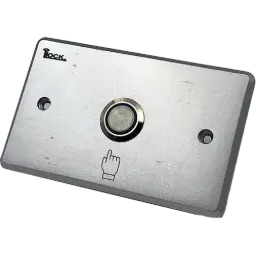
You will also need an exit button (no-touch types work well in clinics), an emergency break-glass on escape doors, a door contact so the system knows when a door is held open, and an access control power supply with a fire alarm input. General units are in our power supply range; pick one with battery backup if the lock is fail-safe.
How Do Link helps
Our Bab El Louk showrooms stock locks and accessories in the SIB access control range, plus ZKTeco and Hikvision access control. Our technical team checks the door type and swing direction with you before you buy. We offer wholesale and project pricing, a one-year warranty, and delivery to every governorate in 2 to 3 working days.
Start with the door
Send us a photo of the door, its material and swing direction through our contact page, and we will recommend the lock, bracket and power supply. For the bigger picture, see our access control solutions.
Recommended products from Do Link

Get a quote from Do Link
Send us your site details and the number of points you need, and Do Link's sales team will reply with suitable models and pricing. Or visit one of our three branches in Bab El Louk, Cairo.
Contact the sales team WhatsApp Call us 01098280784 Request a quote
About Do Link
Do Link for Security Systems is the official Platinum Distributor of Uniview in Egypt, and we supply Hikvision, Dahua, ZKTeco, TP-Link and other global brands for CCTV, networking, intercom and access control. Our products are original with a one-year warranty, pre- and post-sale technical support, and delivery to all Egyptian governorates.
Frequently asked questions
Is a 280 kg maglock enough for a main entrance?
Usually not. Main doors get pushed and tampered with, and real holding force drops with any gap in the installation. We recommend 500 kg locks for main entrances, steel doors and stores, and keep 280 kg for light internal doors, always with careful alignment between the magnet and armature plate.
What is the difference between fail-safe and fail-secure?
A fail-safe lock releases the door when power is lost, like a maglock or most drop bolts. A fail-secure lock stays locked without power and releases when energised, which is common for electric strikes. Escape routes need free exit in emergencies, while fail-secure can suit server rooms if there is mechanical egress from inside.
Which lock suits a double-swing tempered glass door?
The usual choice is a drop bolt concealed in the header, because it works regardless of swing direction. A maglock with glass-door brackets can work in some layouts. Either way, the door hinges or floor spring must be properly adjusted, because even slight sagging stops the bolt from dropping into its strike.
How long will the lock run on battery during a power cut?
It depends on total current draw. Two 500 kg maglocks with a controller and two readers draw about 1.5 A. With a 12 V 7 Ah battery and around 70% usable capacity, expect roughly 3.3 hours. That figure falls as the battery ages, so test batteries regularly and replace weak ones.
Can I power a lock over Cat6 network cable?
We do not recommend it over medium distances. Cat6 conductors have relatively high resistance: over a 30 m run, a 0.5 A lock loses about 2 V and receives only 10 V, which weakens it. Use a copper power cable of 0.75 mm² or larger, depending on distance and current.