



Music blasting next to the speaker, almost nothing in the far corner, and a staff member cranking the amp whenever it gets busy. You see this in plenty of restaurants and cafés that spent heavily on the fit-out and then mounted two big speakers wherever was convenient.
Good background music goes unnoticed. Customers just feel the place is comfortable. Getting there takes some simple planning, which we cover here.
Rule one: low level, many speakers
The classic mistake is relying on two powerful speakers. To reach the back of the room they must be very loud up front, so people near them raise their voices. Staff then raise the music, and the room climbs into a noise spiral driven by the Lombard effect, our automatic habit of speaking louder in noise.
The fix is more small speakers spread evenly, all running at a calm level. Normal conversation sits around 60 dB at one metre, and background music should stay under it, unless the music is the point of the venue.
Split the venue into zones
Each area has different needs, so the system is divided into zones, each with its own level and sometimes its own source.
| Zone | Speaker type | Practical note |
|---|---|---|
| Dining or seating area | Ceiling or wall speakers | Calm, even level |
| Terrace or outdoor seating | Weatherproof wall speakers | Separate level; mind the neighbours |
| Restrooms and corridors | Small ceiling speaker | Very low level |
| Shopfront and entrance | Wall or track speaker | Draw attention without annoying passers-by |
| Kitchen or stockroom | Wall speaker | Mostly for paging, not music |
Clothing stores usually add fitting rooms as their own quieter zone.
Choosing speaker types
- Ceiling speakers: the cleanest option with a false ceiling. They disappear into the design and spread sound evenly from above.
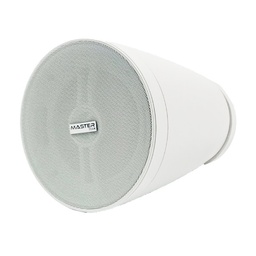
- Wall speakers: where there is no false ceiling or the ceiling is very high. Mount slightly above seated head height, aimed at the seating.
- Track speakers: mount on the lighting track. Good for shops and showrooms with exposed ceilings, and easy to move when the layout changes.
- Outdoor speakers: for terraces and gardens. They must be built for outdoor use with suitable water and dust protection, and their connections need protecting too.
Need technical advice before you buy?
Do Link's sales team helps you choose the right equipment for your site and budget, with special wholesale and project pricing.
Contact the sales team WhatsApp Call us 01098280784 Request a quote
Worked example: a 14 × 7 m café with a terrace
False ceiling at 3 m, seated guests with ears at about 1.2 m. For a 90° ceiling speaker, the coverage radius at ear level is about 3 − 1.2 = 1.8 m, so edge-to-edge spacing is about 3.6 m.
- Main room: 14 ÷ 3.6 ≈ 3.9, round up to 4 along the length; 7 ÷ 3.6 ≈ 1.9, round up to 2 across. That is 8 ceiling speakers. At the 6 W tap: 48 W.
- Terrace: 4 outdoor wall speakers at 10 W = 40 W.
- Two restrooms: 2 speakers at 3 W = 6 W.
Total 48 + 40 + 6 = 94 W. With 25% headroom that is about 118 W, so a 120 W or larger 100 V mixer amplifier, ideally with zone outputs or a zone selector. Background music rarely runs speakers at full tap, but sizing on the selected taps keeps the amplifier out of overload.
100 V line or 8 ohm speakers?
In a very small venue with two to four speakers near the amp, low-impedance 8 Ω speakers on a standard amplifier work, provided you calculate total impedance correctly for the wiring. With more speakers or longer runs, a 100 V line is far easier: every speaker connects in parallel, each one's power is set by its tap, and cable losses are lower.
Volume control and music sources
Put a wall volume control in each zone so staff can adjust the level without touching the amplifier. Some controls support priority override, so a page or emergency message bypasses the local setting at full level. This needs extra wires, so plan it into the cabling from day one.
Give the music its own fixed source, such as a USB player, streamer or small PC, not a staff member's phone, where calls and notifications end up on the speakers. Also make sure your music source permits playback in commercial premises.
Tip for installers: set the final levels at peak hour with the venue full, then mark the right position on each volume control. In an empty room everything sounds loud; in a crowd half the sound vanishes.
Paging and installation
Self-service restaurants, supermarkets and large shops need paging alongside music. A paging mic on an amplifier with ducking (talkover) drops the music while someone speaks, then brings it back. Pages can also go to one zone only, such as the kitchen or stockroom, without interrupting customers.
Plan cable routes with the interior designer before the ceiling closes, mark speaker positions on the ceiling plan next to lighting and AC, keep speaker cable away from mains where you can, and never put a ceiling speaker directly above the cashier who sits under it all shift.
How Do Link helps
We supply background music components from DSPPA, Master Team, Fonestar and others, including ceiling speakers, Master Team wall speakers, track speakers, volume controls and mixer amplifiers. Our technical team helps with zoning, speaker count and amplifier power before you buy. See our PA and sound solutions.
Contractors and restaurant or retail chains get wholesale and project pricing, with a one-year warranty, technical support and delivery to every governorate in 2 to 3 working days.
Send us your floor plan and dimensions through our contact page and we will propose a layout that fits the space and the budget.
Recommended products from Do Link


Get a quote from Do Link
Send us your site details and the number of points you need, and Do Link's sales team will reply with suitable models and pricing. Or visit one of our three branches in Bab El Louk, Cairo.
Contact the sales team WhatsApp Call us 01098280784 Request a quote
About Do Link
Do Link for Security Systems is the official Platinum Distributor of Uniview in Egypt, and we supply Hikvision, Dahua, ZKTeco, TP-Link and other global brands for CCTV, networking, intercom and access control. Our products are original with a one-year warranty, pre- and post-sale technical support, and delivery to all Egyptian governorates.
Frequently asked questions
How many speakers does a café or restaurant need?
It depends on floor area and ceiling height. For a 90 degree ceiling speaker, the coverage radius is roughly ceiling height minus seated ear height. In a 14 by 7 metre café with a 3 metre ceiling, spacing works out around 3.6 metres, so about 8 ceiling speakers for the main room, plus speakers for the terrace and restrooms.
Two big speakers or many small ones?
Many small speakers spread evenly are better for background music. Two big speakers force you to raise the level until it reaches the back, which is uncomfortable for anyone sitting near them and makes people talk louder. Even distribution gives a calm, consistent level at every table and makes zoning simple.
Why split the sound system into zones?
Each area needs a different level. The dining room wants calm music, the terrace needs its own level with the neighbours in mind, restrooms need very low music, and the kitchen is usually for paging only. Zoning with a volume control per zone lets staff adjust each area without affecting the rest of the venue.
100 V line or 8 ohm speakers for a shop?
In a small space with two to four speakers close to the amplifier, 8 ohm speakers work if you calculate the total impedance correctly. With more speakers or longer runs, a 100 V line is easier and more flexible: speakers connect in parallel, each one's power is set by its tap, and cable losses are lower.
Can we play music from a staff member's phone?
We advise against it. Calls, notifications and app sounds end up on the speakers in front of customers, and the music stops when that person leaves with the phone. Use a fixed source such as a USB player, streamer or small PC connected to the amplifier, and confirm your music source allows commercial playback.