



A meeting where someone keeps asking "can you hear me?" has already lost half its time. In most rooms the problem is not cheap equipment. It is equipment that does not fit the room size and the way the room is used, or a room whose acoustics were ignored altogether.
Below: the parts of a conference room system, how to choose each, and a worked ceiling speaker example.
Start with how the room is used
First, how many people sit at the table? Do remote people join on Zoom or Teams? Does a chairperson need to control who speaks?
A six-person huddle room running daily video calls is nothing like a 30-seat boardroom with managed speaking turns and recorded minutes. The first may need one all-in-one device. The second needs a proper system.
| Room type | Typical setup | Notes |
|---|---|---|
| Small room, up to 8 people | USB speakerphone or video bar | Simple install, built for video calls |
| Mid-size room, 10 to 20 people | Table or gooseneck mics, DSP, ceiling speakers | Echo cancellation needed if remote users join |
| Boardroom or council chamber | Discussion system with chair and delegate units, DSP, amplifier | Floor control, chair priority, recording |
Microphones: distance beats price
The closer the mic is to the mouth, the more useful signal it picks up relative to room noise and reverberation. Halving the distance raises the captured level by about 6 dB. That is why a gooseneck 20 to 40 cm from the talker sounds far clearer than a ceiling mic two metres away.
- Gooseneck: clearest for speech and aimed at each talker. The natural choice for boardrooms.
- Boundary: lies flat on the table and covers several people. Tidier, but it hears paper shuffling and knuckle taps.
- Ceiling mics: keep the table clear, but need a treated room and a good DSP because they sit far from the talkers.
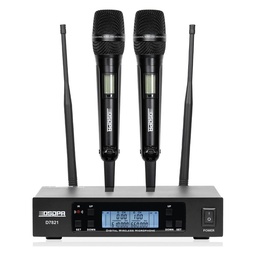
- Wireless: for the presenter walking in front of the screen.
Delegate units and discussion systems
Where speaking time is managed, a discussion system is used: a central controller, a chair unit and delegate units. Each unit usually combines a gooseneck mic, a request-to-speak button and a small built-in speaker or headphone output, linked by the system's own cabling.
What you gain: a limit on how many mics can be open at once, a chair priority button that temporarily mutes everyone else, and a recording output for minutes. When comparing systems, check the maximum units per controller, the allowed cable length and how the system expands later.
Need technical advice before you buy?
Do Link's sales team helps you choose the right equipment for your site and budget, with special wholesale and project pricing.
Contact the sales team WhatsApp Call us 01098280784 Request a quote
DSP: where the echo goes
"Echo" means two different things in a meeting room, and each has its own fix.
Echo the far end hears
On a video call, the remote voice plays through your speakers, your mics pick it up and send it back with a delay. The fix is acoustic echo cancellation (AEC) in a DSP or all-in-one device. AEC needs a reference signal, the far-end audio itself, so the PC or codec audio must pass through the processor before it reaches the amplifier.
Reverberation in the room
Glass walls, hard floors and solid ceilings hold sound long after it stops, smearing syllables together. A DSP cannot fix this alone. You need carpet, curtains, absorber panels or an acoustic ceiling. Designers usually aim for a short reverberation time in speech rooms, around 0.6 seconds or less.
Other DSP functions worth having: an automatic mixer that opens the active mic and ducks the rest, automatic gain control to even out loud and soft voices, and EQ per mic and per speaker zone.
Feedback and open microphones
Feedback happens when a mic picks up a speaker and re-amplifies it in a loop. Every doubling of the number of open mics cuts the available gain before feedback by about 3 dB, so eight mics open together lose roughly 9 dB compared with one.
Tip for installers: never put a ceiling speaker directly above the table facing the goosenecks. Move speakers toward the room edges, enable auto-mixing or cap the number of open mics in the discussion system, and you gain real headroom before feedback.
Speakers: a ceiling layout worked out
For ceiling speakers with 90° coverage, the coverage radius at ear level is roughly the ceiling height minus seated ear height.
Take a 9 × 6 m room with a 3 m ceiling and seated ear height of about 1.2 m:
- Coverage radius = 3 − 1.2 = 1.8 m.
- Edge-to-edge: spacing = 2 × 1.8 = 3.6 m, giving 3 along the length (9 ÷ 3.6 = 2.5, round up) × 2 across (6 ÷ 3.6 = 1.7, round up) = 6 speakers.
- Minimum overlap on a square grid: spacing = 1.8 × 1.41 ≈ 2.5 m, giving 4 × 3 = 12 speakers and much more even level across every seat.
For speech, many designers lean toward overlap, since intelligibility suffers in the dips between speakers. In small rooms, two wall speakers at the front may be enough, especially when audio follows a display.
Signal flow and mistakes we see often
The logical chain is microphones (or the discussion system controller), then the DSP, then the amplifier, then the speakers. PC and video codec audio also enters the DSP, which sends the mic mix back to the codec for the far end. In small rooms a mixer amplifier can replace a separate DSP and amp, but it usually has no echo cancellation, so it is a poor fit for rooms built around video calls.
- Great mics in an untreated glass room, with the volume pushed up to fight reverberation.
- PC audio wired straight to the amplifier, bypassing the DSP, so AEC never sees its reference.
- Long unbalanced mic runs beside mains cable, causing hum that is hard to trace. Use balanced XLR connections for long runs.
- Levels set on install day but never saved, so the next user changes them. Store presets and lock the control panel.
How Do Link helps
We carry audio components from DSPPA, Fonestar and Master Team, including DSPPA microphones, ceiling speakers, amplifiers and Master Team mixers. Our technical team reviews your room dimensions and how it is used, then proposes mic and speaker placement before you buy. See our PA and sound solutions for more.
Contractors and companies get project pricing, with a one-year warranty, pre- and post-sale support and delivery across Egypt. Our branches in Bab El Louk, Cairo are open daily from 10 AM to 10 PM.
Send us the room plan, headcount and how you use the room through our contact page, or start by browsing Master Team ceiling speakers.
Recommended products from Do Link



Get a quote from Do Link
Send us your site details and the number of points you need, and Do Link's sales team will reply with suitable models and pricing. Or visit one of our three branches in Bab El Louk, Cairo.
Contact the sales team WhatsApp Call us 01098280784 Request a quote
About Do Link
Do Link for Security Systems is the official Platinum Distributor of Uniview in Egypt, and we supply Hikvision, Dahua, ZKTeco, TP-Link and other global brands for CCTV, networking, intercom and access control. Our products are original with a one-year warranty, pre- and post-sale technical support, and delivery to all Egyptian governorates.
Frequently asked questions
Gooseneck or boundary microphone for a meeting room?
A gooseneck sits close to the talker's mouth and points at them, so it delivers clearer speech and picks up less room noise. It suits boardrooms and formal discussions. A boundary mic lies flat on the table and covers several people, which looks tidier but also catches paper noise and table taps. It works well in small and mid-size rooms.
Why does the remote side hear their own voice echoing?
Their voice plays through your room speakers, your microphones pick it up and send it back with a delay. The fix is acoustic echo cancellation in a DSP or all-in-one device. The PC or codec audio must pass through the processor before the amplifier, so the processor knows which signal to remove from the microphones.
How many ceiling speakers does a meeting room need?
It depends on floor area and ceiling height. For a 90 degree speaker, coverage radius is roughly ceiling height minus seated ear height. In a 9 by 6 metre room with a 3 metre ceiling that radius is 1.8 metres, giving 6 speakers edge to edge, or about 12 on an overlapping grid for even coverage across every seat.
How do I avoid feedback with many microphones?
Keep fewer mics open at once, because every doubling of open mics cuts gain before feedback by about 3 dB. Use an automatic mixer in the DSP or the open-mic limit in your discussion system, keep speakers from facing the microphones, and bring the mic closer to the talker instead of turning up the gain.
Do I need a discussion system or are ordinary mics enough?
If speaking is managed in turns and the chair needs priority and recorded minutes, a discussion system is the practical choice because it controls open mics and gives the chair a priority button. For open discussions in small and mid-size rooms, table mics with an auto-mixing DSP usually do the job at a lower cost.