



In many mosques the sound gets louder and the words get lost at the same time. Worshippers in the back rows hear the imam less clearly the more the volume goes up. The problem is rarely speaker power. It is the room itself: a dome, marble walls, columns and hard surfaces bouncing sound around many times.
This article is for mosque committees, technicians and contractors, and it focuses on what actually makes the difference: speaker type and position, zoning, and the choice of amplifier and microphones.
Why mosques are acoustically difficult
When a talker stops, sound keeps lingering in the room. That decay is the reverberation time. Carpeted, curtained rooms have short decay; in mosques with high domes and hard walls it can stretch to two seconds or more in large halls, and syllables smear into each other.
Speech intelligibility is measured with STI on a scale of 0 to 1, and PA systems commonly target 0.5 or higher. The working rule: the more direct sound reaches the listener compared with reflected sound, the clearer the speech. That means more speakers, closer to the worshippers, at a calmer level, instead of a few loud ones.
Column speakers: why they are the usual choice
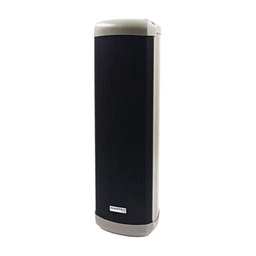
A column speaker stacks several small drivers vertically. This narrows vertical dispersion while keeping horizontal coverage wide, so sound goes to the rows of worshippers and less of it reaches the dome and ceiling. More direct sound, less reverberation.
- Mount on columns or side walls at roughly 2 to 2.5 m, tilted slightly down toward the congregation.
- Spread speakers along the hall so no row sits far from its nearest speaker, rather than two big boxes at the front.
- Do not aim a speaker at a nearby hard wall or at the imam's microphone.
- For the women's section and low ceilings, ceiling or small wall speakers fit better.
Delay in large mosques
Sound travels at about 343 m/s, so every metre takes roughly 2.9 ms. In a large mosque a worshipper at the back hears the nearby speaker instantly, then the front speakers or the imam's natural voice arrive later, and the speech sounds doubled.
Example: a speaker 20 m from the imam's position. Direct sound arrives after about 20 × 2.9 ≈ 58 ms. Delay that speaker by this amount plus around 10 ms and the listener perceives the voice as coming from the front, without the doubling. You need a DSP with delay for this; small mosques usually do not.
Need technical advice before you buy?
Do Link's sales team helps you choose the right equipment for your site and budget, with special wholesale and project pricing.
Contact the sales team WhatsApp Call us 01098280784 Request a quote
Zoning and amplifier sizing
Mosque systems usually run on 100 V lines: each speaker has a small transformer with power taps, and all speakers connect in parallel on one line. Add up the selected taps, add 20 to 25% headroom, then pick the amplifier.
| Zone | Speaker type | Qty × tap | Total |
|---|---|---|---|
| Main prayer hall | Column speakers | 12 × 20 W | 240 W |
| Women's section | Ceiling speakers | 6 × 6 W | 36 W |
| Minaret / outdoor | Horn speakers | 4 × 30 W | 120 W |
Inside: 240 + 36 = 276 W, about 345 W with 25% headroom, so a 350 W or larger amplifier with two zone outputs. Outside: 120 × 1.25 = 150 W, so a separate amplifier of 150 W or more.
Why a separate minaret amp? Outdoor level and settings are completely different from indoors, and one failed amplifier will not silence the whole mosque. A volume control for the women's section lets it be adjusted on its own. For outdoor speakers, follow the official rules governing loudspeaker use.
Microphones for the imam, minbar and adhan
- Imam during prayer: a wireless headset or lavalier, since he moves between standing, bowing and prostration. A headset keeps a constant distance from the mouth; a lavalier changes level with posture and can rub on clothing.
- Minbar: a fixed gooseneck on a stand suited to the speaker's height.
- Adhan and iqama: a wired dynamic mic that handles loud, close voice without distortion.
Tip for installers: tune the system with the mosque full or close to full if you can, since people and clothing absorb sound and change the room's balance. Keep a wired backup mic connected and ready, and fresh batteries in the wireless mic before Friday prayer.
Common mistakes we see
- Adding an artificial echo effect to the imam's voice inside a hall that already has too much reverberation.
- Running indoor and outdoor speakers from one amplifier at one level.
- Installing a few high-power speakers at the front only, so the first row is blasted and the last row hears mush.
- Using thin speaker cable over long runs, so a share of the amplifier power is lost in the cable itself.
- Leaving the amplifier open to anyone. Mark the final settings, or store them in the processor and lock it, and name one person responsible. Switch sources on first and amplifiers last, and the reverse when shutting down, to avoid speaker-damaging thumps.
How Do Link helps
We supply mosque audio components from DSPPA, Master Team and Fonestar, including DSPPA column speakers, Master Team column speakers, amplifiers and microphones. Our technical team reviews the mosque layout and dimensions and proposes speaker count, positions, zoning and amplifier power before you buy. See our PA and sound solutions.
Contractors get project pricing, with a one-year warranty, pre- and post-sale support and delivery to every governorate in 2 to 3 working days.
Send us the mosque dimensions and a few photos of the hall through our contact page, or browse speaker cables and the rest of the system in our shop.
Recommended products from Do Link



Get a quote from Do Link
Send us your site details and the number of points you need, and Do Link's sales team will reply with suitable models and pricing. Or visit one of our three branches in Bab El Louk, Cairo.
Contact the sales team WhatsApp Call us 01098280784 Request a quote
About Do Link
Do Link for Security Systems is the official Platinum Distributor of Uniview in Egypt, and we supply Hikvision, Dahua, ZKTeco, TP-Link and other global brands for CCTV, networking, intercom and access control. Our products are original with a one-year warranty, pre- and post-sale technical support, and delivery to all Egyptian governorates.
Frequently asked questions
Why is the imam unclear even though the speakers are loud?
Usually the problem is reverberation, not power. Hard walls and domes reflect sound many times so words overlap, and turning the volume up raises the reverberation with it. The fix is more speakers closer to the worshippers at a calmer level, using column speakers that aim sound at the rows and send less of it to the dome and ceiling.
What is the advantage of column speakers in a mosque?
Stacking drivers vertically narrows the vertical spread while keeping horizontal coverage wide. Sound goes to the rows of worshippers and less reflects off the dome and ceiling, which raises the ratio of direct to reflected sound and improves clarity. They are normally mounted on columns or side walls, tilted slightly down toward the congregation.
How do I size the amplifier for a mosque?
On a 100 V line system, add up the tap settings of every speaker on that amplifier and allow 20 to 25% headroom. For example, 12 column speakers at 20 W and 6 ceiling speakers at 6 W total 276 W, which calls for an amplifier of about 350 W. A separate amplifier for the outdoor and minaret speakers is recommended.
Which microphone suits the imam during prayer?
A wireless mic, since the imam moves between standing, bowing and prostration. A headset keeps a fixed distance from the mouth and gives a steadier level. A lavalier is less visible but its level changes with posture and it can rub on clothing. Always fit fresh batteries and keep a wired backup mic connected and ready.
Does a mosque sound system need a delay processor?
Small and mid-size mosques usually do not. In large mosques where rear speakers sit tens of metres from the imam, sound from the front arrives late and the speech seems doubled. Delaying the rear speakers by the matching time, about 2.9 milliseconds per metre, removes that doubling and noticeably improves clarity for the back rows.