



A farm off a desert road, a construction site with no utility power yet, a well or a telecom shelter in the middle of nowhere: all need watching, none has a fixed internet line or steady electricity. 4G cameras on solar power are built for exactly this, but they only work if the energy and data numbers are done properly. Most complaints about these systems come down to an undersized panel or a data bundle that runs out mid-month.
Two very different kinds of system
Low-power, wake-on-motion cameras
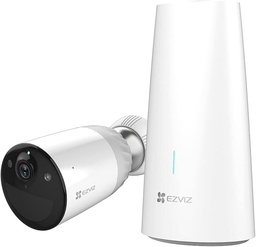
A camera with an internal battery and a small panel that sleeps most of the time until a PIR sensor wakes it to record a clip and send an alert. Daily consumption is tiny, so a small panel is enough. The trade-off: no continuous recording, a possible gap of a second or two at the start of an event, and a short delay when opening live view. Fine for a farm gate or a small store. See similar ideas in our EZVIZ battery cameras.
Always-on systems
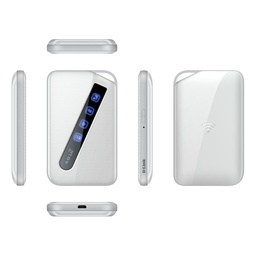
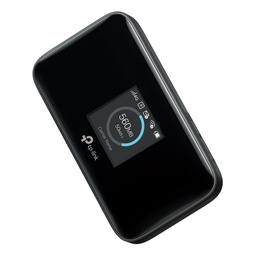
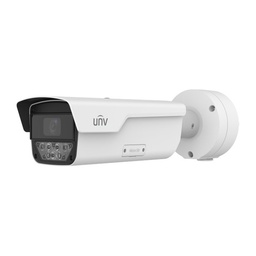
A 4G camera recording continuously, or standard IP cameras with a 4G router, all running from a large battery and a bigger panel. You get a full archive and instant viewing, but the power budget must be right. For several cameras, a D-Link 4G router or a TP-Link MiFi can serve Uniview IP cameras or others.
Power budget: a full example
Take a 4G camera running 24/7. Get the real consumption from the datasheet; it rises at night with IR on. Here we assume a 6 W average.
| Step | Calculation | Result |
|---|---|---|
| Daily energy | 6 W x 24 h | 144 Wh |
| Two days of autonomy for cloud and dust | 144 Wh x 2 | 288 Wh |
| Nominal battery at 80% depth of discharge (LiFePO4) | 288 / 0.8 | 360 Wh |
| At 12 V | 360 / 12 | 30 Ah |
| Panel (4 winter peak sun hours, 75% overall efficiency) | 144 / (4 x 0.75) | 48 W minimum |
| Practical panel | margin for dust and recharging after weak days | about 80 W |
The 75% covers charge controller, cabling and heat losses. With a standard IP camera plus a separate 4G router, total draw can approach 12 W and every figure roughly doubles: 288 Wh a day, a 60 Ah battery and a 100 to 160 W panel. That is why we always ask what goes inside the box and for each device's datasheet. Egypt has excellent sunshine, but dust on desert and farm sites cuts panel output noticeably, so panel cleaning belongs in routine maintenance.
How much mobile data does a camera use?
This is the most expensive mistake. A camera streaming upstream nonstop at 1 Mbps uses 86,400 megabits a day, about 10.8 GB, or roughly 324 GB a month. No sensible mobile plan covers that. The rule is record locally, use the network only for viewing and alerts. Record to an SD card in the camera or to an on-site recorder. A moderate usage estimate:
- 30 minutes of live view a day on a 512 kbps sub-stream: about 115 MB a day, roughly 3.5 GB a month.
- 20 event clips a day, 20 seconds each at 2 Mbps: about 100 MB a day, roughly 3 GB a month.
- Total around 7 GB per camera per month, with some headroom for updates and cloud signalling.
Use a surveillance-grade microSD card, since it will write constantly in high heat. Mobile connections usually sit behind carrier-grade NAT, so port forwarding is not an option; remote access goes through the manufacturer's P2P cloud app.
Need technical advice before you buy?
Do Link's sales team helps you choose the right equipment for your site and budget, with special wholesale and project pricing.
Contact the sales team WhatsApp Call us 01098280784 Request a quote
Placement that keeps it running
- Panel facing south, tilted roughly at the site latitude for year-round output: about 30 degrees around Cairo and the Delta, a bit less in Upper Egypt.
- No shade from trees, buildings or tanks at any time of day; even partial shading can drag down a whole panel.
- Camera high enough to be out of reach, with anti-theft brackets and a locked battery box.
- Battery box shaded and ventilated. Heat shortens lithium battery life, and some cameras stop charging above the temperature limit in their specs.
- Proper earthing for tall poles in open ground.
- Test signal at the exact mounting point with the same operator's SIM. The strongest network varies from one farm to the next, and an external antenna helps where supported.
Tip for installers: most 4G camera "failures" on remote sites are expired bundles, not hardware faults. Turn on auto-renewal, log the SIM number and renewal date in the site file, and confirm the device supports your operator's frequency bands before installing.
Farms are not construction sites
The maths is the same; the site changes the design. On farms, targets are scattered: the gate, the fertiliser and equipment store, the pump room, livestock sheds. Cover entry points and valuable assets rather than the whole land, and when they are hundreds of metres apart, a standalone camera with its own SIM and panel per point is simpler than long cable runs through ploughed and irrigated ground. Construction sites change every month as fences move and buildings rise, so favour poles or mobile bases that are easy to relocate, aimed at the materials store, the gate and heavy-equipment parking. Where a generator runs a few hours a day, it can top up the battery and shrink the solar array. And once one point needs more than three or four cameras, a small recorder in a protected box with a single 4G router saves both data and power compared with several SIMs.
Mistakes we see often
- A panel sized for summer that leaves the camera dead every winter night.
- A car battery instead of a deep-cycle battery, worn out within months.
- Continuous cloud upload switched on, bundle gone in days.
- Mounting before checking coverage.
How Do Link can help
Through our CCTV solutions we supply IP cameras, battery cameras, 4G routers and memory cards from original brands such as Uniview, Hikvision, EZVIZ, D-Link and TP-Link. Send us the site layout, camera count and distances, and our technical team will work out power and data with you and suggest models currently in stock. Contractors get project pricing, and we deliver to every governorate in 2 to 3 working days. Start by sending your site details through our contact page.
Recommended products from Do Link
Get a quote from Do Link
Send us your site details and the number of points you need, and Do Link's sales team will reply with suitable models and pricing. Or visit one of our three branches in Bab El Louk, Cairo.
Contact the sales team WhatsApp Call us 01098280784 Request a quote
About Do Link
Do Link for Security Systems is the official Platinum Distributor of Uniview in Egypt, and we supply Hikvision, Dahua, ZKTeco, TP-Link and other global brands for CCTV, networking, intercom and access control. Our products are original with a one-year warranty, pre- and post-sale technical support, and delivery to all Egyptian governorates.
Frequently asked questions
Does a solar camera work at night?
Yes. At night it runs from the battery that the panel charged during the day, which is why the battery is sized to cover the whole night plus a reserve of one or two days for cloudy or dusty weather. If a camera dies at night in winter, the panel or battery is usually undersized, or the panel needs cleaning.
How much data does a 4G camera use per month?
If it records locally to an SD card and uses the network only for viewing and alerts, moderate use is around 7 GB per camera per month. Continuous upload at 1 Mbps would use about 324 GB a month, which is impractical, so we do not recommend continuous cloud recording over a mobile network.
Can I use a car battery with the solar panel?
We advise against it. A car battery is built to deliver a high current for a few seconds at engine start, not to be deeply discharged and recharged every day, so it wears out quickly in these systems. Use a LiFePO4 or deep-cycle battery with a suitable charge controller, kept in a shaded, ventilated box.
Can I reach a 4G camera with port forwarding?
Usually not. Mobile connections typically sit behind the operator's carrier-grade NAT without a public IP, so the camera cannot be reached directly from outside. The standard approach is the manufacturer's app using its P2P cloud service, which works behind these networks without any router configuration on your side.
Battery camera or always-on 4G camera: which do I need?
A battery camera sleeps and wakes on motion to record short clips, so it uses very little energy and needs only a small panel. An always-on camera gives a full archive and instant live view but needs a bigger battery, a larger panel and careful power sizing. Choose based on how critical the site is and whether you need continuous footage.