




A camera that works all day then drops or reboots every night, picture rolling with lines, a far camera that only works if the adapter is moved next to it. Most of these faults have nothing to do with the camera. They come from the cable and the power, and power in particular is usually guessed on site, even though one simple formula settles it.
This article compares coax with UTP and video baluns, explains central 12 V power supplies, and calculates voltage drop over distance with real numbers.
Coax or UTP with baluns?
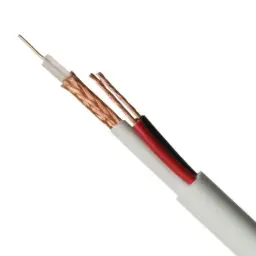
Coax (75 Ω) is the native medium for analog cameras. RG59 is the most common; RG6 is thicker with lower loss for longer runs. Combined RG59-plus-power cable saves pulling a separate power line. Two things decide quality: a solid copper centre conductor rather than copper-clad steel or aluminium, and a dense braid shield.
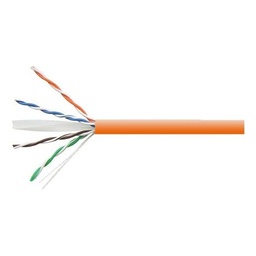
UTP with baluns: a balun at each end carries analog video over one twisted pair. A Cat5e or Cat6 cable has four pairs, so you can carry several cameras with multi-channel baluns, or use one pair for video and others for power. It is cheaper, lighter, easier to pull, and ready for IP cameras later. Passive baluns usually reach less distance than good coax at high resolutions, and balun quality matters a lot.
| Criterion | RG59 coax | UTP with baluns |
|---|---|---|
| Interference | Good, braid shield | Good, twisted pairs, if baluns are good |
| Cameras per cable | One | Up to four video channels, or one camera plus power |
| Move to IP later | Needs EoC or new cable | Direct |
| Weak points | Poor BNC connectors | Cheap baluns, CCA cable |
See our CCTV cables and network cables.
The voltage drop formula
Every copper wire has resistance, and current through it drops voltage. The camera does not get the 12 V the supply outputs; it gets 12 V minus the drop in both the feed and return wires:
Voltage drop = 2 × length × current × resistivity ÷ conductor cross-section
Length is one-way in metres, current in amps, copper resistivity about 0.0172 Ω·mm²/m, cross-section in mm². The 2 accounts for the return path.
Example: 12 V camera, 0.5 A, 50 m away
Use the maximum night-time current with IR on. Cat6 is 23 AWG, about 0.258 mm² per conductor; two conductors in parallel per pole give about 0.516 mm².
| Conductor | Drop | Voltage at camera | Drop % |
|---|---|---|---|
| Cat6, 2 wires per pole (0.516 mm²) | 1.67 V | 10.33 V | 13.9% |
| 0.75 mm² power cable | 1.15 V | 10.85 V | 9.6% |
| 1.0 mm² power cable | 0.86 V | 11.14 V | 7.2% |
| 1.5 mm² power cable | 0.57 V | 11.43 V | 4.8% |
Many cameras accept 12 V ±10%, down to about 10.8 V, and some accept a wider range per the datasheet. Here Cat6 is out of range and 0.75 mm² is right on the edge. That explains the camera that reboots only at night: IR switches on, current rises, drop rises, voltage falls below the limit.
Maximum length for a 10% drop
Rearranged: max length = allowed drop × cross-section ÷ (2 × current × 0.0172). With 1.2 V allowed: 0.516 mm² gives about 36 m at 0.5 A and 18 m at 1 A; 0.75 mm² about 52 m and 26 m; 1.0 mm² about 70 m and 35 m; 1.5 mm² about 105 m and 52 m. These are for solid copper. Copper-clad aluminium (CCA) has noticeably higher resistance, so allowed lengths shrink considerably.
Central 12 V power supply boxes
A central supply box next to the recorder replaces individual adapters, with separately fused outputs. One faulty camera trips only its own output, and all maintenance is in one place. Add up maximum night current for all cameras and add 25 to 30% headroom: eight cameras at 0.5 A is 4 A, so choose at least 5 A, more if expansion is likely. Check the per-output current limit too, ventilate the box, and put it on the UPS with the recorder. Some supplies let you trim the output voltage up to offset drop, but that also raises the voltage on nearby cameras; a heavier conductor is the safer fix. Browse our CCTV power supplies.
Tip for installers: measure voltage with a multimeter at the camera end, at night, with the IR on, not at the supply during the day. That one reading resolves half of all "camera drops at night" complaints.
Need technical advice before you buy?
Do Link's sales team helps you choose the right equipment for your site and budget, with special wholesale and project pricing.
Contact the sales team WhatsApp Call us 01098280784 Request a quote
Cabling mistakes we see often
- Running camera cables alongside 220 V mains for long distances, which causes lines and noise. Separate the routes and cross at right angles.
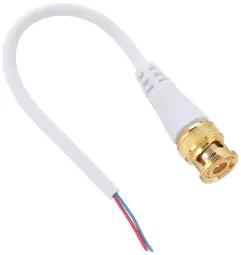
- Poor or hand-twisted BNC connectors. Use proper connectors with the right tool.
- Exposed outdoor joints with no waterproof junction box; they corrode within months.
- Cheap CCA cable to save a little, followed by days of chasing an intermittent fault.
- Powering cameras of one system from different supplies in separate buildings, which creates a ground loop and slow rolling bars. Use one supply where possible, a video isolator, or fibre between buildings.
- Unlabelled cables. Number every cable at both ends and leave a sensible service loop.
Junction boxes and mounts are in our installation accessories.
What about IP cameras?
With IP cameras, power usually moves to PoE over the network cable, rated to work up to 100 m. 802.3af delivers up to 15.4 W at the switch port, about 12.95 W at the device after cable loss, enough for most fixed cameras. The math is easier, but cable quality still matters: CCA causes PoE problems too.
How Do Link helps
Do Link supplies coax and copper network cable, central power supplies, connectors, baluns and junction boxes, alongside Uniview cameras as Uniview's Platinum Distributor in Egypt, plus Hikvision, Dahua and more. Our technical team can review cable lengths and camera consumption with you and suggest the right conductor size and supply, with installer pricing and delivery to all governorates. See our CCTV solutions, or send your camera count and approximate cable lengths through our contact page and we will work out the power with you before installation.
Recommended products from Do Link

Get a quote from Do Link
Send us your site details and the number of points you need, and Do Link's sales team will reply with suitable models and pricing. Or visit one of our three branches in Bab El Louk, Cairo.
Contact the sales team WhatsApp Call us 01098280784 Request a quote
About Do Link
Do Link for Security Systems is the official Platinum Distributor of Uniview in Egypt, and we supply Hikvision, Dahua, ZKTeco, TP-Link and other global brands for CCTV, networking, intercom and access control. Our products are original with a one-year warranty, pre- and post-sale technical support, and delivery to all Egyptian governorates.
Frequently asked questions
Why does my camera work by day and drop at night?
The most common cause is voltage drop. When the infrared switches on at night, the camera draws more current, the drop along the cable rises, and the voltage at the camera falls below what it needs, so it reboots. Measure voltage at the camera end at night, and use a thicker conductor or a closer supply if needed.
Is network cable better than coax for analog cameras?
Each has strengths. UTP with good baluns is cheaper, easier to pull, carries more than one camera and is ready for IP later. Good coax usually reaches further at high resolutions. In both cases, use solid copper and quality baluns and connectors.
How do I size a central CCTV power supply?
Add the maximum current of all cameras from their datasheets, using the night figure with IR on, then add about 25 to 30% headroom. For example, eight cameras at 0.5 A need 4 A, so choose at least a 5 A supply. Also check the maximum current per output, not just the total rating.
Can I power a camera over the same network cable as the video?
Yes, using one pair for video through a balun and other pairs for power. But network cable conductors are thin, so voltage drop is high. For a 0.5 A camera with two wires per pole, the maximum length for a 10% drop is only about 36 m in solid copper, and less with CCA cable.
Does raising the supply voltage above 12 V help?
Some supplies let you trim the output up slightly to offset drop on long runs. However, this raises the voltage on every camera on that supply, including close ones with no drop, which may exceed their allowed range. The safer fix is a thicker conductor or a separate supply near the far cameras.