



A camera pole on a farm, a construction site or a desert road station, with no power for hundreds of metres. Solar is the obvious answer, yet most failed systems we see did not fail because of the sun. They failed because of an undersized panel, a battery cooking inside a metal box, or a charge controller that did not match the battery. This article is about the power system itself: load, panel, battery, controller and cabling.
Start with the real load
Every later figure depends on this one, and any error multiplies. Add up each device from its datasheet and watch three things. Night consumption is higher, because IR illuminators and, on some models, heaters switch on. The 4G router runs around the clock and is often forgotten. And voltage conversion costs energy: a PoE camera on a 12 V system needs a DC-DC converter to PoE voltage, which is never 100% efficient.
Worked example: two cameras and a 4G router
One pole carries two PoE IP cameras averaging 6 W each, a 6 W 4G router, and a PoE converter around 90% efficient.
| Item | Calculation | Result |
|---|---|---|
| Cameras after conversion loss | (2 × 6) ÷ 0.9 | 13.3 W |
| Total load | 13.3 + 6 | about 20 W |
| Daily energy | 20 × 24 | 480 Wh |
| Panel (4 winter peak sun hours, 75% overall efficiency) | 480 ÷ (4 × 0.75) | 160 W minimum |
| Practical panel | 2 × 100 W | 200 W |
| Battery, two days autonomy | 480 × 2 | 960 Wh usable |
| LiFePO4 at 80% depth of discharge | 960 ÷ 0.8 ÷ 12.8 | about 94 Ah, so 100 Ah |
| AGM at 50% depth of discharge | 960 ÷ 0.5 ÷ 12 | 160 Ah, so 2 × 100 Ah |
The 75% covers controller losses, battery round-trip losses, cabling, panel heat and dust. The extra panel capacity is for recovery: on a winter day 200 W gives about 200 × 4 × 0.75 = 600 Wh, a 120 Wh daily surplus to refill the battery after a cloudy or dusty day.
Four peak sun hours is a conservative winter figure for northern Egypt; Upper Egypt does better. For your exact site use free tools such as PVGIS or Global Solar Atlas, and design for the weakest month, not the annual average.
Battery: lithium or lead-acid
LiFePO4 costs more up front, but allows deeper discharge, survives far more cycles and weighs less than half as much as equivalent lead-acid. In the example, one 100 Ah lithium battery replaces two lead-acid units, which matters on a pole. Heat is the real enemy in Egypt: a sealed metal box in summer sun can pass 60 °C inside. Many LiFePO4 datasheets limit charging to roughly 0 to 45 °C, and lead-acid life roughly halves for every 8 to 10 °C above 25 °C.
Tip for installers: keep the battery box in shade, on the north side of the pole or under the panel, ventilated but dust-protected, and avoid dark paint. A few degrees cooler buys years of battery life.
Need technical advice before you buy?
Do Link's sales team helps you choose the right equipment for your site and budget, with special wholesale and project pricing.
Contact the sales team WhatsApp Call us 01098280784 Request a quote
MPPT or PWM controller
A PWM controller ties the panel almost directly to the battery, so the panel runs at battery voltage instead of its maximum power point. That works with 36-cell panels (Vmp around 18 V) on a 12 V battery, but larger high-voltage panels lose much of their output. An MPPT controller tracks the maximum power point and converts excess voltage into charging current. For anything beyond a few tens of watts, we recommend MPPT.
Sizing: 200 W into a 12 V battery is about 200 ÷ 13.5 ≈ 15 A, so a 20 A MPPT controller. With panels in series, keep total open-circuit voltage (Voc) below the controller's maximum PV input with margin, since Voc rises on cold mornings. Set the correct battery profile (a lead-acid profile is wrong for lithium) and use the load output's low-voltage disconnect to protect the battery.
Cabling: voltage drop at 12 V
Panels 10 m from the controller, 15 A, so a 20 m loop. Copper is about 0.0175 Ω per metre per mm².
- 4 mm²: 20 × 0.0175 ÷ 4 ≈ 0.088 Ω, drop ≈ 1.3 V, about 7% of 18 V.
- 6 mm²: about 0.9 V, roughly 5%.
- 10 mm²: about 0.53 V, under 3%.
Use a bigger cable or move the controller closer to the panels, and use UV-resistant solar cable on exposed runs.
Installation and upkeep
Face the panel true south, tilted near the site latitude (about 30° in Cairo), a little steeper if winter output is the priority. Avoid shade all day: partial shade on a few cells can cut output from the whole panel sharply. Dust on desert and farm sites reduces output noticeably, so panel cleaning belongs on the maintenance visit list. Earth the pole, and fit surge protection on any network cable that runs back to a building. A controller with remote battery readings lets you spot decline before the camera goes dark.
How Do Link can help
Within our CCTV solutions we supply low-power Hikvision IP cameras and Uniview IP cameras, 4G routers for off-grid sites, EZVIZ battery cameras for small points, and camera power supplies. Our technical team will help you calculate the load and pick cameras that fit the power budget, with project and wholesale pricing, nationwide delivery and a one-year warranty.
Send us the camera count and site location and we will help you work out the daily load. Contact our team to get started.
Recommended products from Do Link
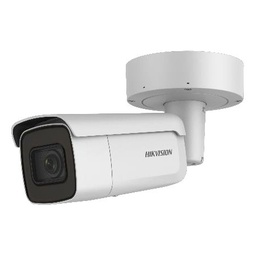 Hikvision DS-2CD2665G0-IZS 6 MP IR Varifocal Bullet Network CameraDS-2CD2665G0-IZS
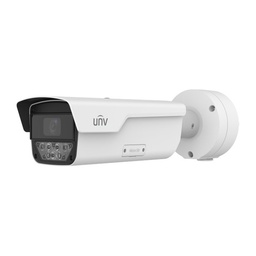 Uniview PKC2640@Z28-IR-P 4MP LPR Bullet Camera 2.8-12mm IRPKC2640@Z28-IR-P
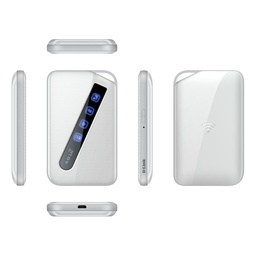 D-Link DWR-930M LTE 4G/HSPA 3000mAh battery router with support LTE BandDWR-930M
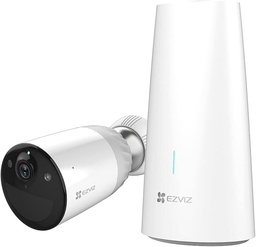 EZVIZ CS-BC1-B1 2 MP Outdoor Battery Camera Kit with HubCS-BC1-B1
Get a quote from Do Link
Send us your site details and the number of points you need, and Do Link's sales team will reply with suitable models and pricing. Or visit one of our three branches in Bab El Louk, Cairo.
Contact the sales team WhatsApp Call us 01098280784 Request a quote
About Do Link
Do Link for Security Systems is the official Platinum Distributor of Uniview in Egypt, and we supply Hikvision, Dahua, ZKTeco, TP-Link and other global brands for CCTV, networking, intercom and access control. Our products are original with a one-year warranty, pre- and post-sale technical support, and delivery to all Egyptian governorates.
Frequently asked questions
How big a solar panel does one CCTV camera need?
It depends on the camera's average draw and anything running with it, such as a router. Multiply consumption by 24 hours for daily energy, then divide by winter peak sun hours times an overall efficiency of about 75%. A 6 W camera alone needs roughly 50 W as a minimum, and a larger panel is better so the battery recovers after weak days.
Is lithium better than lead-acid for solar CCTV?
LiFePO4 costs more to buy but allows deeper discharge, lasts many more charge cycles and weighs less than half as much as equivalent lead-acid. Over the life of the system it is usually the cheaper option, especially on poles. Protect it from excess heat and make sure the charge controller is set to the correct lithium battery profile.
Should I use an MPPT or a PWM charge controller?
A PWM controller makes the panel run near battery voltage, which suits small 36-cell panels on a 12 V battery. An MPPT controller tracks the panel's maximum power point and turns excess voltage into charging current, harvesting more energy and allowing higher-voltage panels. For anything beyond a few tens of watts we recommend MPPT.
Why do batteries in solar camera systems fail early?
The usual causes are heat inside a sealed metal box in direct sun, repeated deep discharge because the panel is undersized, and a charge controller set for the wrong battery type. Shade and ventilate the battery box, size the panel with enough margin to recharge, and enable the low-voltage disconnect so the battery is never drained completely.