




Previous
Next
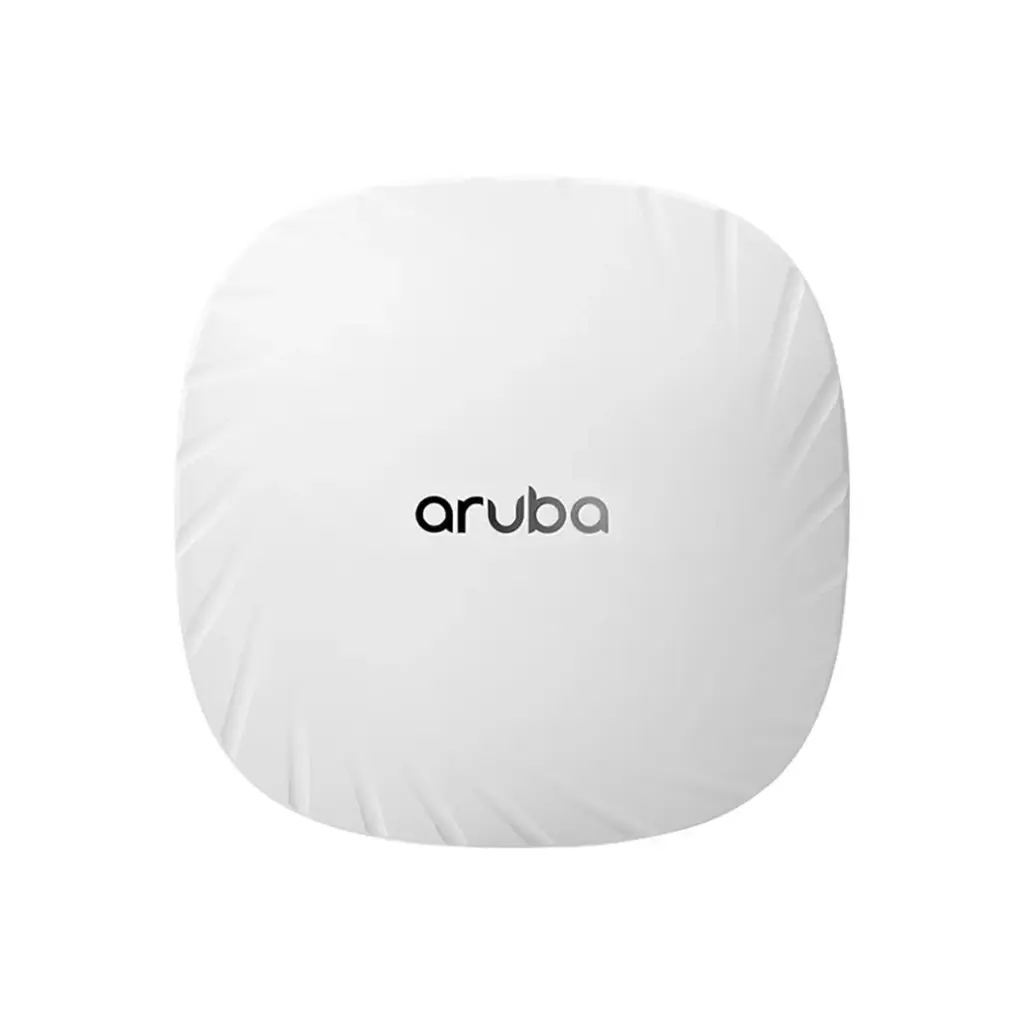

Product Code:
AP-505
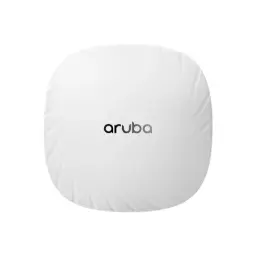
Aruba AP-505 Campus Access Point Wireless Indoor Router AP WiFi 6 Enterprise
Aruba AP-505 Campus Access Point Wireless Indoor Router AP WiFi 6 Enterprise is a Router product. Review its technical specifications and product data to select the right solution from Do Link Egypt.
AP-505
- WiFi 6 Performance: Dual radio 802.11ax with up to 1.49 Gbps max real-world speed.
- Advanced Security: Features WPA3 and Enhanced Open security protocols.
- Sticky Client Resolution: Built-in technology resolves sticky client issues for Wi-Fi 6 and 5.
- Multi-User Efficiency: OFDMA technology enhances multi-user efficiency.
- IoT Ready: Supports Bluetooth 5 and Zigbee for IoT applications.
General
| Model | AP-505 |
|---|
Technical Specifications
| Model | AP-505 |
| Technical Specifications | |
| Access point type | Indoor, dual radio, 5 GHz and 2.4 GHz 802.11ax 2x2 MIMO |
| 5 GHz radio | Two spatial stream Single User (SU) MIMO for up to 1.2 Gbps wireless data rate with 2SS HE80 802.11ax client devices |
| 2.4 GHz radio | Two spatial stream Single User (SU) MIMO for up to 574 Mbps (287 Mbps) wireless data rate with 2SS HE40 (HE20) 802.11ax client devices |
| Maximum number of associated client devices | Up to 256 associated client devices per radio |
| Maximum number of BSSIDs | 16 BSSIDs per radio |
| Supported frequency bands (country-specific restrictions apply) | 2.4 GHz and 5 GHz / 2.400 to 2.4835 GHz (ISM) / 5.150 to 5.250 GHz (U-NII-1) / 5.250 to 5.350 GHz (U-NII-2A) / 5.470 to 5.725 GHz (U-NII-2C) / 5.725 to 5.850 GHz (U-NII-3/ISM) / 5.850 to 5.895 GHz (U-NII-4) |
| Available channels | Dependent on configured regulatory domain |
| Supported radio technologies | 802.11b: Direct-sequence spread-spectrum (DSSS) / 802.11a/g/n/ac: Orthogonal frequency-division multiplexing (OFDM) / 802.11ax: Orthogonal frequency-division multiple access (OFDMA) with up to 8 resource units |
| Supported modulation types | 802.11b: BPSK, QPSK, CCK / 802.11a/g/n: BPSK, QPSK, 16-QAM, 64-QAM, 256-QAM (proprietary extension) / 802.11ac: BPSK, QPSK, 16-QAM, 64-QAM, 256-QAM, 1024-QAM (proprietary extension) / 802.11ax: BPSK, QPSK, 16-QAM, 64-QAM, 256-QAM, 1024-QAM |
| 802.11n high-throughput (HT) support | HT20/40 |
| 802.11ac very high throughput (VHT) support | VHT20/40/80 |
| 802.11ax high efficiency (HE) support | HE20/40/80 |
| Supported data rates (Mbps) | 802.11b: 1, 2, 5.5, 11 / 802.11a/g: 6, 9, 12, 18, 24, 36, 48, 54 / 802.11n: 6.5 to 300 (MCS0 to MCS15, HT20 to HT40), 400 with 256-QAM / 802.11ac: 6.5 to 867 (MCS0 to MCS9, NSS = 1 to 2, VHT20 to VHT80), 1,083 with 1024-QAM / 802.11ax (2.4 GHz): 3.6 to 574 (MCS0 to MCS11, NSS = 1 to 2, HE20 to HE40) / 802.11ax (5 GHz): 3.6 to 1,201 (MCS0 to MCS11, NSS = 1 to 2, HE20 to HE80) |
| 802.11n/ac/ax packet aggregation | A-MPDU, A-MSDU |
| Transmit power | Configurable in increments of 0.5 dBm |
| Maximum (aggregate, conducted total) transmit power | 2.4 GHz band: +21 dBm (18 dBm per chain) / 5 GHz band: +21 dBm (18 dBm per chain) |
| Wi-Fi Antennas | |
| AP-505 | Two integrated dual-band downtilt omni-directional antennas for 2x2 MIMO with peak antenna gain of 4.9 dBi in 2.4 GHz and 5.7 dBi in 5 GHz; downtilt angle for maximum gain roughly 30 degrees / Peak gain of the combined, average pattern: 4.3 dBi in 2.4 GHz and 5.6 dBi in 5 GHz |
| Other Interfaces | |
| E0: Ethernet wired network port (RJ-45) | Auto-sensing link speed (10/100/1000BASE-T) and MDI/MDIX / PoE-PD: 48Vdc (nominal) 802.3af/at PoE (class 3 or 4) / 802.3az Energy Efficient Ethernet (EEE) |
| DC power interface | 12 Vdc (nominal, +/- 5%), accepts 2.1 mm/5.5 mm center-positive circular plug with 9.5mm length |
| USB 2.0 host interface (type A connector) | Capable of sourcing up to 1A / 5W to an attached device |
| Bluetooth low energy (BLE5.0) and Zigbee (802.15.4) radio | BLE: up to 7 dBm transmit power (class 1) and -93 dBm receive sensitivity (1 Mbps) / Zigbee: up to 6 dBm transmit power and -96 dBm receive sensitivity / Integrated vertically polarized omnidirectional antenna with roughly 30 degrees downtilt and peak gain of 3.3 dBi |
| Visual indicators (two multi-color LEDs) | For system and radio status |
| Reset button | Factory reset, LED mode control (normal/off) |
| Serial console interface | Proprietary, micro-B USB physical jack |
| Security slot | Kensington security slot |
| Power Sources and Power Consumption | |
| Power sources | The access point supports direct DC power and Power over Ethernet / When both DC and PoE power sources are available, DC power takes priority over PoE / Power sources are sold separately |
| Maximum (worst-case) power consumption (without/with a USB device attached) | DC powered: 8.9W / 14.2W; PoE powered (802.3at): 11.0W / 16.5W; PoE powered (802.3af): 11.0W / 13.5W |
| Maximum (worst-case) power consumption in idle mode | 4.3W (DC) or 6.2W (PoE) |
| Maximum (worst-case) power consumption in deep-sleep mode | 1.7W (DC) or 3.7W (PoE) |
| Mechanical Specifications | |
| Dimensions/weight (unit, excluding mount bracket) | 160 mm (W) x 161 mm (D) x 37 mm (H) / 500g |
| Dimensions/weight (shipping) | 193 mm (W) x 183 mm (D) x 63 mm (H) / 645g |
| Mounting details | A mounting bracket has been pre-installed on the back of the access point; used to secure the AP to any of the mount kits (sold separately) |
| Environmental Specifications | |
| Operating conditions | Temperature: 0°C to +50°C / +32°F to +122°F / Humidity: 5% to 93% non-condensing / AP is plenum rated for use in air-handling spaces / ETS 300 019 class 3.2 environments |
| Storage and transportation conditions | Temperature: -40°C to +70°C / -40°F to +158°F / Humidity: 5% to 93% non-condensing / ETS 300 019 classes 1.2 and 2.3 environments |
| Reliability | |
| Mean time between failure (MTBF) | 1.3 Mhrs (148yrs) at +25°C operating temperature |
| Regulatory and Safety Compliance | |
| Minimum OS release | HPE Aruba Networking Wireless Operating System and HPE Aruba Networking InstantOS 8.6.0.0 / HPE Aruba Networking Wireless Operating System 10.1.0.0 |
No PDF files or external links are attached to this product yet.
Frequently bought together
Products that complete the same system
Need help choosing?
Want to learn more?
Talk to a Do Link specialist for sizing, integration and on-site support.